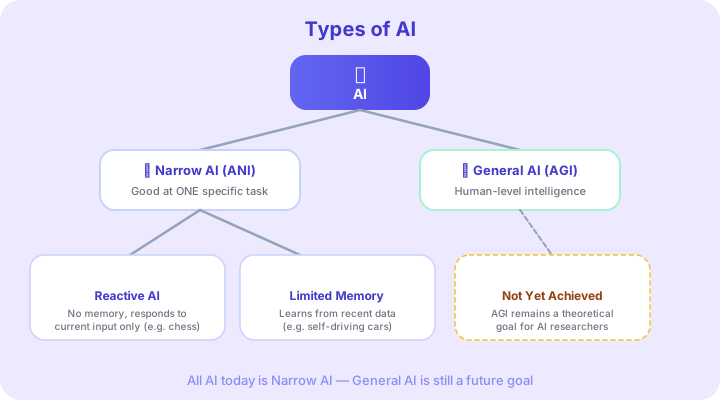
Not all AI is created equal. When people talk about artificial intelligence, they might mean anything from a spam filter to a sentient robot. Let's clear up the confusion by looking at the three main categories.
Narrow AI is designed to do one specific thing really well. It can't do anything outside its training. Every AI system you interact with today is narrow AI:
Don't let the word "weak" fool you. Narrow AI can be extraordinarily powerful at its specific task - often far better than any human. It's "weak" only in the sense that it can't generalise beyond what it was built for.
AGI would be a system that can learn and perform any intellectual task a human can. It could switch from writing code to composing music to diagnosing an illness - all without being specifically trained for each one.
Think of narrow AI as a world-class sprinter who can only run in a straight line. AGI would be a decathlete - competent at everything.
Does AGI exist? No. Not yet. Some researchers believe we're getting closer, while others think it's decades away - or may not be possible at all. It's one of the biggest debates in technology today.
Which of the following best describes AGI?
ASI goes beyond human ability in every area - scientific creativity, social skills, strategic thinking, everything. This is the stuff of science fiction.
If AGI is a decathlete, ASI would be an athlete who breaks every world record in every sport simultaneously.
Sign in to join the discussion
ASI doesn't exist and may never exist. But it's worth understanding the concept because it drives a lot of the conversation around AI safety and regulation.
Researchers also group AI by how it processes information:
The simplest type. They respond to inputs with no memory of past interactions. IBM's Deep Blue (the chess computer) was reactive - it evaluated the board each turn from scratch.
Most modern AI lives here. These systems learn from historical data and use recent context to make decisions. Self-driving cars, recommendation engines, and ChatGPT all use limited memory - they remember your conversation, but only for that session.
This would be AI that understands emotions, beliefs, and intentions - the way humans naturally read each other. Current AI can simulate empathy in text, but it doesn't truly understand your feelings.
AI that has genuine consciousness and self-awareness. This remains firmly in the realm of philosophy and science fiction. No AI system today has anything close to self-awareness.
Models like GPT-4, Claude, and Gemini are narrow AI with limited memory. Yes, they seem remarkably versatile - they can write essays, solve maths problems, translate languages, and generate code. But they're still doing one fundamental thing: predicting the next likely word (or token) based on patterns learned from training data.
They don't understand concepts the way you do. They're extraordinarily good at pattern-matching, which can look a lot like understanding - but it's not the same thing.
What type of AI is ChatGPT?
Understanding these categories helps you:
Which type of AI currently exists?
The gap between narrow AI and AGI is enormous. But narrow AI is already transforming industries, creating new jobs, and reshaping how we live. You don't need science fiction to be amazed by what's happening right now.