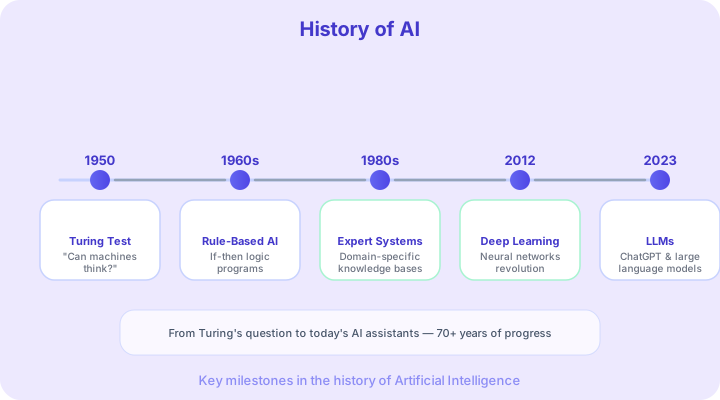
Artificial intelligence didn't appear overnight. It's a story of brilliant ideas, bold predictions, frustrating setbacks, and jaw-dropping breakthroughs. Let's walk through the timeline together.
In 1950, British mathematician Alan Turing published a paper called Computing Machinery and Intelligence. In it, he proposed what we now call the Turing Test: if a machine can hold a conversation so convincingly that a human can't tell whether they're chatting with a person or a computer, we might say that machine can "think."
Turing didn't build an AI himself - but he gave the world the question that launched the entire field.
In the summer of 1956, a small group of researchers gathered at Dartmouth College in New Hampshire, USA. They coined the term "artificial intelligence" and made a remarkably optimistic prediction: they believed machines would be able to do anything a human mind could within a generation.
That didn't quite happen - but the conference officially launched AI as a field of study.
Early AI programs could solve algebra problems, play draughts, and even carry on basic conversations (like the chatbot ELIZA in 1966). Funding poured in. Governments and universities believed human-level AI was just around the corner.
What was ELIZA?
Reality hit hard. Computers were too slow, data was scarce, and early AI couldn't handle real-world messiness. Funding dried up, and critics called AI overhyped. This bleak period became known as the first AI winter.
Think of it like planting seeds in frozen ground - the ideas were good, but the technology wasn't ready yet.
In the 1980s, expert systems became popular. These were programs loaded with human-written rules - for example, "if the patient has a fever AND a rash, consider measles." Companies spent millions building them.
But expert systems were brittle. They couldn't learn or adapt. When business results disappointed, a followed in the late 1980s.
Sign in to join the discussion
Everything changed in 2012 when a neural network called AlexNet crushed the competition in the ImageNet image-recognition challenge. It didn't use hand-written rules - it learned from millions of images.
This breakthrough proved that deep learning (neural networks with many layers) actually worked when you had enough data and computing power. Suddenly, tech giants started investing billions.
| Year | Milestone | |------|-----------| | 1950 | Turing proposes the Turing Test | | 1956 | "Artificial intelligence" coined at Dartmouth | | 1966 | ELIZA chatbot created | | 1997 | IBM Deep Blue beats chess champion Garry Kasparov | | 2011 | IBM Watson wins Jeopardy! | | 2012 | AlexNet wins ImageNet - deep learning takes off | | 2016 | DeepMind's AlphaGo beats world Go champion Lee Sedol | | 2017 | Google publishes the Transformer architecture paper | | 2022 | ChatGPT launches and reaches 100 million users in two months |
In 2017, Google researchers published a paper titled Attention Is All You Need, introducing the Transformer architecture. This design allowed AI models to process language far more effectively than anything before.
Transformers power today's large language models - GPT-4, Claude, Gemini, and others. They're the reason you can have a natural conversation with an AI chatbot right now.
What was the name of the 2017 paper that introduced the Transformer architecture?
AI is evolving faster than ever. We're seeing multimodal models that handle text, images, and audio together. The next chapter is being written right now - and understanding the history helps you make sense of where we're heading.
What caused the AI winters?