AI EducademyAIEducademy
๐ŸŒณ

AI Foundations

๐ŸŒฑ
AI Seeds

Start from zero

๐ŸŒฟ
AI Sprouts

Build foundations

๐ŸŒณ
AI Branches

Apply in practice

๐Ÿ•๏ธ
AI Canopy

Go deep

๐ŸŒฒ
AI Forest

Master AI

๐Ÿ”จ

AI Mastery

โœ๏ธ
AI Sketch

Start from zero

๐Ÿชจ
AI Chisel

Build foundations

โš’๏ธ
AI Craft

Apply in practice

๐Ÿ’Ž
AI Polish

Go deep

๐Ÿ†
AI Masterpiece

Master AI

๐Ÿš€

Career Ready

๐Ÿš€
Interview Launchpad

Start your journey

๐ŸŒŸ
Behavioral Mastery

Master soft skills

๐Ÿ’ป
Technical Interviews

Ace the coding round

๐Ÿค–
AI & ML Interviews

ML interview mastery

๐Ÿ†
Offer & Beyond

Land the best offer

View All Programsโ†’

Lab

7 experiments loaded
๐Ÿง Neural Network Playground๐Ÿค–AI or Human?๐Ÿ’ฌPrompt Lab๐ŸŽจImage Generator๐Ÿ˜ŠSentiment Analyzer๐Ÿ’กChatbot Builderโš–๏ธEthics Simulator
๐ŸŽฏMock InterviewEnter the Labโ†’
JourneyBlog
๐ŸŽฏ
About

Making AI education accessible to everyone, everywhere

โ“
FAQ

Common questions answered

โœ‰๏ธ
Contact

Get in touch with us

โญ
Open Source

Built in public on GitHub

Get Started
AI EducademyAIEducademy

MIT Licence. Open Source

Learn

  • Academics
  • Lessons
  • Lab

Community

  • GitHub
  • Contribute
  • Code of Conduct
  • About
  • FAQ

Support

  • Buy Me a Coffee โ˜•
  • Terms of Service
  • Privacy Policy
  • Contact
AI & Engineering Academicsโ€บ๐ŸŒฟ AI Sproutsโ€บLessonsโ€บAI Ethics and Bias
โš–๏ธ
AI Sprouts โ€ข Beginnerโฑ๏ธ 15 min read

AI Ethics and Bias

AI Ethics and Bias

Throughout this programme, we have explored how data, algorithms, and neural networks come together to create intelligent systems. But intelligence without responsibility can cause real harm. In this final lesson, we examine the human side of AI - the biases it inherits, the ethical dilemmas it raises, and what we can all do about it.

What Is AI Bias?

AI bias occurs when a system produces results that are systematically unfair to certain groups of people. The AI is not deliberately prejudiced - it simply reflects the patterns in its training data and the assumptions of its designers.

Real-World Examples

Amazon's Hiring Tool (2018) Amazon built an AI to screen job applications. It was trained on CVs submitted over the previous ten years - a period when the tech industry was overwhelmingly male. The AI learned to penalise CVs that contained the word "women's" (as in "women's chess club") and downgraded graduates from all-women's universities. Amazon scrapped the tool.

Facial Recognition Failures Research by Joy Buolamwini at MIT found that commercial facial recognition systems had error rates of up to 34.7% for darker-skinned women, compared to just 0.8% for lighter-skinned men. The training data simply did not represent all faces equally.
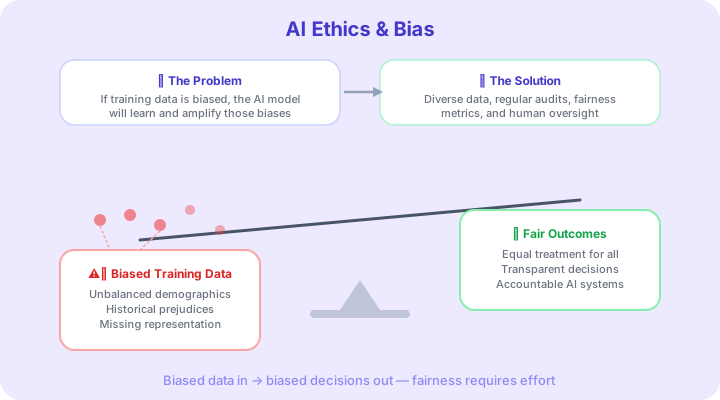
A balance scale with a dataset on one side and diverse human figures on the other, illustrating the need for balanced, representative data in AI
Fair AI requires balanced data - when the scales tip, so do the outcomes.
๐Ÿง Quick Check

Why did Amazon's AI hiring tool discriminate against women?

Where Does Bias Come From?

Bias can enter an AI system at every stage:

  • Data collection - If the data over-represents one group, the model learns to favour that group.
  • Labelling - Human annotators bring their own unconscious biases when tagging data.
  • Feature selection - Choosing which variables to include (or exclude) can embed assumptions.
  • Evaluation - If we only test on certain demographics, we miss failures on others.
๐Ÿ’ก

AI does not create bias from thin air. It amplifies the biases already present in human decisions, historical records, and societal structures. The data is a mirror - and sometimes we do not like what it reflects.

Lesson 5 of 160% complete
โ†Training AI Models

Discussion

Sign in to join the discussion

Suggest an edit to this lesson

Deepfakes and Misinformation

AI can now generate realistic fake videos, images, and audio - known as deepfakes. While the technology has creative uses (film effects, accessibility tools), it also poses serious risks:

  • Political manipulation - Fabricated videos of public figures saying things they never said.
  • Fraud - Voice cloning used to impersonate executives and authorise fraudulent transactions.
  • Harassment - Non-consensual fake imagery targeting private individuals.

Detecting deepfakes is becoming an arms race. As generation tools improve, so must detection tools - but they are always playing catch-up.

๐Ÿคฏ

In 2019, criminals used AI-generated voice cloning to impersonate a CEO and trick an employee into transferring ยฃ220,000. The voice was so convincing that the employee never suspected it was fake.

๐Ÿค”
Think about it:

If you saw a video of a world leader declaring war, how would you verify whether it was real? What tools or sources would you trust? In a world of deepfakes, critical thinking about media becomes a survival skill.

Job Displacement and Economic Impact

AI automates tasks that were previously done by humans. This creates both opportunities and challenges:

Tasks at risk of automation:

  • Data entry and processing
  • Basic customer service (chatbots)
  • Routine legal document review
  • Simple medical image screening

Tasks less likely to be automated:

  • Creative problem-solving
  • Complex human relationships (therapy, teaching, leadership)
  • Work requiring physical dexterity in unpredictable environments
  • Ethical judgement and nuanced decision-making

The key distinction is between automating tasks and replacing jobs. Most jobs are collections of many tasks - AI tends to automate some tasks within a role rather than eliminating the role entirely.

๐Ÿง Quick Check

Which type of work is LEAST likely to be fully automated by AI?

Privacy Concerns

AI systems are hungry for data, and that hunger raises significant privacy questions:

  • Surveillance - Facial recognition in public spaces enables mass tracking without consent.
  • Data collection - Voice assistants, fitness trackers, and social media constantly gather personal information.
  • Profiling - AI can infer sensitive information (health conditions, political views, sexuality) from seemingly innocuous data patterns.

The tension is real: more data generally makes AI better, but collecting more data can violate individual privacy.

๐Ÿคฏ

Researchers demonstrated that AI could predict a person's sexual orientation from a photo with higher accuracy than humans - raising profound questions about privacy, consent, and the limits of what AI should be allowed to infer.

Responsible AI Principles

Leading organisations have converged on a set of principles for building AI responsibly:

Fairness

AI should treat all people equitably. Models should be tested across different demographics to ensure no group is disadvantaged.

Transparency

People affected by AI decisions deserve to understand how those decisions are made. Black-box models should be accompanied by explanations.

Accountability

There must be clear ownership when AI causes harm. "The algorithm did it" is not an acceptable defence.

Privacy

AI systems must respect data protection laws and individual rights. Data collection should be minimised to what is truly necessary.

Safety

AI should be tested rigorously before deployment, especially in high-stakes domains like healthcare, criminal justice, and finance.

๐Ÿค”
Think about it:

If an AI system denies someone a loan, who is responsible - the developer who built the model, the bank that deployed it, or the data that trained it? Accountability in AI is one of the hardest questions we face.

๐Ÿง Quick Check

Which responsible AI principle states that people should understand how AI decisions are made?

What You Can Do as a Learner

You do not need to be an AI engineer to make a difference. Here is how you can contribute to more responsible AI:

  • Ask questions - When you encounter an AI system, ask: whose data trained this? Who benefits and who might be harmed?
  • Stay informed - Follow developments in AI ethics. The landscape changes rapidly.
  • Demand transparency - Support organisations and products that explain how their AI works.
  • Diversify perspectives - If you go on to build AI, ensure your teams and your data represent the diversity of the people the system will serve.
  • Think critically - Not every AI application is a good idea, even if it is technically possible.
๐Ÿ’ก

Technology is not neutral. The choices made by the people who build, deploy, and regulate AI shape the world we all live in. Your awareness and your voice matter.

Key Takeaways

  • AI bias comes from biased data, not from the algorithm itself being prejudiced.
  • Deepfakes pose serious risks to trust, security, and privacy.
  • AI automates tasks rather than replacing entire jobs - but the impact is still significant.
  • Privacy is at risk when AI systems collect and infer personal information at scale.
  • Responsible AI rests on fairness, transparency, accountability, privacy, and safety.
  • Everyone has a role to play in shaping how AI is built and used.

Congratulations - you have completed Level 2: Foundations! You now understand how data, algorithms, neural networks, training, and ethics come together in the world of AI. The next step is to get hands-on.