Linked Lists and Stacks
Beyond Arrays - Dynamic Data
Arrays are brilliant when you know the size of your data upfront. But what happens when data arrives unpredictably - a stream of sensor readings, a queue of tasks for an AI to process, or a conversation history that grows with every message? You need structures that grow and shrink gracefully.
Enter linked lists, stacks, and queues - the dynamic trio.
Linked Lists - Nodes and Pointers
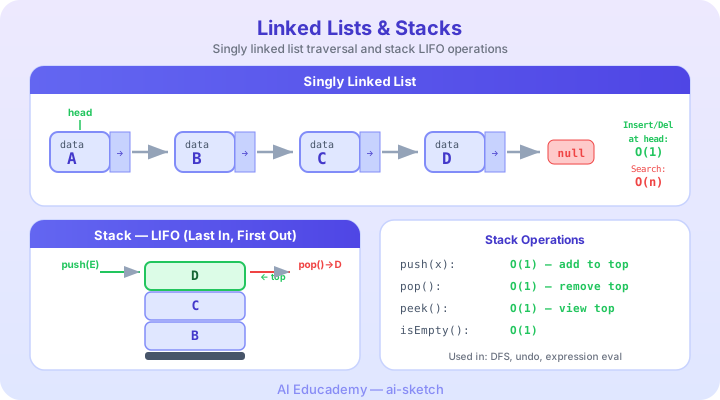
A linked list stores items as a chain of nodes. Each node holds two things: the data itself, and a pointer (reference) to the next node in the chain.
[data: "A" | next: →] → [data: "B" | next: →] → [data: "C" | next: null]
Unlike arrays, linked list nodes don't sit side by side in memory. They can be scattered anywhere - the pointer simply tells you where to find the next one.
Linked Lists vs Arrays
| Operation | Array | Linked List | |-----------|-------|-------------| | Access by index | O(1) ⚡ | O(n) 🐢 | | Insert at beginning | O(n) 🐢 | O(1) ⚡ | | Insert in middle | O(n) 🐢 | O(1)* ⚡ | | Delete from middle | O(n) 🐢 | O(1)* ⚡ | | Memory usage | Compact | Extra (pointers) |
*Once you've found the position - finding it is still O(n).
When Linked Lists Win
- Frequent insertions and deletions: If you're constantly adding and removing items from the middle of a collection, linked lists avoid the costly shifting that arrays require.
- Unknown size: When you don't know how many items you'll store, linked lists grow one node at a time without needing to resize.
- Building other structures: Stacks, queues, and more complex structures are often built on top of linked lists.
Your browser's tab bar lets you open, close, and rearrange tabs freely. Would an array or a linked list be a better fit for managing the list of open tabs? Consider what happens when you close a tab in the middle.
Stacks - Last In, First Out (LIFO)
A stack works exactly like a stack of plates: you add to the top and remove from the top. The last item placed on the stack is the first one taken off.
Discussion
Sign in to join the discussion