AI EducademyAIEducademy
AcademicsLabBlogAbout
Sign In
AI EducademyAIEducademy

Free AI education for everyone, in every language.

Learn

  • Academics
  • Lessons
  • Lab
  • Dashboard
  • About

Community

  • GitHub
  • Contribute
  • Code of Conduct

Support

  • Buy Me a Coffee โ˜•

Free AI education for everyone

MIT Licence. Open Source

Programsโ€บ๐ŸŒฑ AI Seedsโ€บLessonsโ€บWhat is AI? A Friendly Introduction
๐Ÿค–
AI Seeds โ€ข Beginnerโฑ๏ธ 10 min read

What is AI? A Friendly Introduction

Welcome! ๐Ÿ‘‹

If you've ever heard people talk about "AI" and thought "What even is that?" โ€” you're in exactly the right place.

By the end of this lesson, you'll understand what AI is, how it's different from regular software, and why it matters. No coding, no maths โ€” just plain language.

๐ŸŽฌ AI in 100 Seconds โ€” Fireship
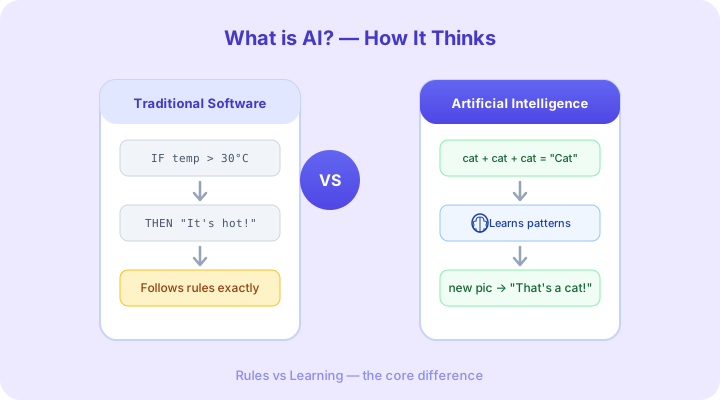
Traditional software follows rules. AI learns patterns from data.
The core difference: rules vs learning

Let's Start with Something You Already Know

Have you ever used any of these?

  • ๐Ÿ“ฑ Phone unlocking with your face โ€” You hold up your phone, it sees your face, and unlocks
  • ๐ŸŽฌ Netflix suggestions โ€” "Because you watched X, you might like Y"
  • ๐Ÿ—ฃ๏ธ Siri, Alexa, or Google Assistant โ€” You ask a question, it answers
  • ๐Ÿ“ท Google Photos โ€” It automatically groups photos of the same person together
  • ๐ŸŒ Google Translate โ€” Type in English, get French (or Telugu, or Hindi!)

All of these use AI.

But what does that actually mean?

๐Ÿง Quick Check

Which of these is an example of AI in everyday life?


So What IS Artificial Intelligence?

Let's break it down word by word:

  • Artificial = Made by humans (not natural)
  • Intelligence = The ability to learn, understand, and make decisions

So Artificial Intelligence is simply: software that can learn from experience and make decisions, rather than just following fixed instructions.

๐Ÿค”
Think about it:

Think about a calculator. You press 2 + 2, it gives you 4. It follows exact rules โ€” every time. That's regular software.

Now think about Netflix. It doesn't follow one fixed rule. It learns what you like by watching your behaviour, and it gets better over time. That's AI.


Regular Software vs AI โ€” What's the Difference?

| Regular Software | AI Software | |---|---| | Follows exact rules written by a programmer | Learns patterns from examples | | Always gives the same output for the same input | Can give different answers based on what it's learned | | Can't improve on its own | Gets better with more data | | Example: A calculator | Example: Netflix recommendations |

Here's a simple way to remember it:

Regular software = A recipe book. It follows the steps exactly.

AI = A chef who tastes the food and adjusts the seasoning based on experience.


How Does AI "Learn"?

You might be thinking: "But it's just a computer. How can it learn?"

Great question! Here's how it works, in simple terms:

  1. You give it lots of examples โ€” Like showing it thousands of photos of cats and dogs
  2. It finds patterns โ€” It notices that cats have pointy ears and dogs have floppy ears (usually!)
  3. It makes predictions โ€” When you show it a new photo, it guesses: "That looks like a cat"
  4. It gets feedback โ€” If it's wrong, it adjusts. If it's right, it remembers that pattern

This is called machine learning โ€” and it's the most common type of AI today.

๐Ÿง Quick Check

What is the correct order of how AI learns?

๐Ÿคฏ

When you teach a toddler to recognise animals, you show them pictures: "This is a cat. This is a dog." After seeing enough examples, they can recognise new cats and dogs they've never seen before. AI learns the same way!


AI is Everywhere (You Just Don't Notice It)

Here are real examples of AI you probably use every day:

AI in daily life: Google Search, spam filters, Maps, Spotify, and career fields
From your morning commute to your evening playlist โ€” AI is everywhere

๐Ÿ” Google Search

When you type a question, AI understands what you mean โ€” even if you make a spelling mistake. It's not just matching keywords; it's understanding your intent.

๐Ÿ“ง Email Spam Filter

Your email doesn't follow a list of "bad words." It's learned from billions of spam emails to recognise patterns โ€” and it keeps getting better.

๐Ÿ—บ๏ธ Google Maps

When Maps tells you "There's traffic on your usual route, here's a faster way" โ€” that's AI analysing real-time data from millions of phones.

๐ŸŽต Spotify / YouTube

"Discover Weekly" playlists and "Recommended for you" videos โ€” AI learns your taste by comparing you to millions of similar users.


What AI CAN'T Do (Yet)

AI is powerful, but it's not magic. Here's what it can't do:

  • โŒ Think like a human โ€” AI doesn't "understand" things the way you do. It finds patterns in data.
  • โŒ Have feelings โ€” Despite what films show, AI doesn't have emotions or consciousness.
  • โŒ Work without data โ€” If you don't give it examples to learn from, it can't do anything.
  • โŒ Be right all the time โ€” AI makes mistakes, sometimes confidently. It's as good as the data it was trained on.

Important: When someone says "AI will replace all jobs" or "AI will take over the world" โ€” that's science fiction, not reality. AI is a tool, like electricity or the internet. It's powerful, but it needs humans to guide it.


Why Should You Care About AI?

Whether you become a programmer, a doctor, a teacher, or an artist โ€” AI will be part of your world:

  • Doctors use AI to detect diseases in X-rays earlier than human eyes can
  • Farmers use AI to predict when to water crops
  • Teachers use AI to personalise lessons for each student
  • Artists use AI to generate ideas and create new forms of art

Understanding AI โ€” even just the basics โ€” helps you:

  1. Make better decisions about technology
  2. Spot when AI is being used (and when it might be wrong)
  3. Participate in the conversation about how AI should be used in society


Quick Recap ๐ŸŽฏ

Let's review what you've learned:

  1. AI = software that learns from experience instead of following fixed rules
  2. Machine learning = the most common type of AI, where software learns from examples
  3. AI is already everywhere โ€” your phone, email, maps, music, and more
  4. AI has limits โ€” it's not conscious, it makes mistakes, and it needs data
  5. Understanding AI matters โ€” it's shaping the world, and you should be part of the conversation
๐Ÿง Quick Check

Which statement about AI is TRUE?


What's Next? ๐Ÿš€

In the next lesson, we'll look at how machines actually learn โ€” the process of training AI, explained with simple examples you can relate to.

No maths required. We promise. ๐Ÿ˜Š

Lesson 1 of 30 of 3 completed
โ†Back to programHow Machines Learnโ†’