💬
AI Polish • Intermediate⏱️ 20 min read
Communicating System Design — Think Out Loud
Communicating System Design — Think Out Loud
System design interviews test how you think, not just what you know. The structure of your answer matters as much as the content.
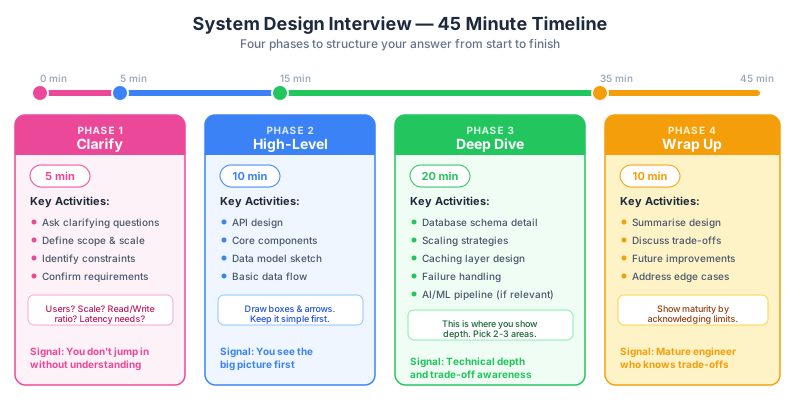
The 4-Phase Framework
Phase 1: Clarify Requirements (5 minutes)
Never start designing immediately. Ask questions first.
- Functional requirements — What does the system do?
- Non-functional requirements — Scale, latency, availability targets
- Scope — What's in vs out for this conversation?
- Users — Who uses it? How many? Read/write ratio?
Questions to always ask:
- "How many daily active users should we design for?"
- "What's the expected read-to-write ratio?"
- "Are there latency requirements?"
- "Should I focus on the backend, or include the client?"
💡
Asking clarifying questions is a signal of seniority. Junior engineers jump into solutions. Senior engineers define the problem first.
Phase 2: High-Level Design (10 minutes)
Sketch the big picture before details.
- API design — Define 2-3 core endpoints
- Core components — Load balancer, app servers, database, cache
- Data model — Key entities and relationships (keep it simple)
- Data flow — How does a request travel through the system?
Draw as you talk:
- Boxes for services
- Arrows for data flow
- Labels for technologies
- Note capacity at each layer
Phase 3: Deep Dive (20 minutes)
This is where you show depth. Pick 2-3 areas based on the problem.
- Database design — Schema, indexing strategy, sharding approach
- Scaling — Horizontal scaling, load balancing, auto-scaling
- Caching — What to cache, TTL strategy, invalidation
- Messaging — Async processing, event-driven patterns, queues
- AI/ML pipeline — Feature store, model serving, A/B testing (if relevant)
🤔
Think about it:
"I'm going to focus on the database layer and caching because those are the likely bottlenecks at this scale. Let me know if you'd prefer I go deeper on another area." — This one sentence shows structured thinking, prioritisation, and collaboration.
Phase 4: Wrap Up & Trade-offs (10 minutes)
End strong by demonstrating engineering maturity.
- Summarise your design in 30 seconds
- Discuss trade-offs you made and why
- Identify limitations — what would break at 100x scale?
- Propose improvements — what would you add with more time?
- Address edge cases — failure modes, data consistency
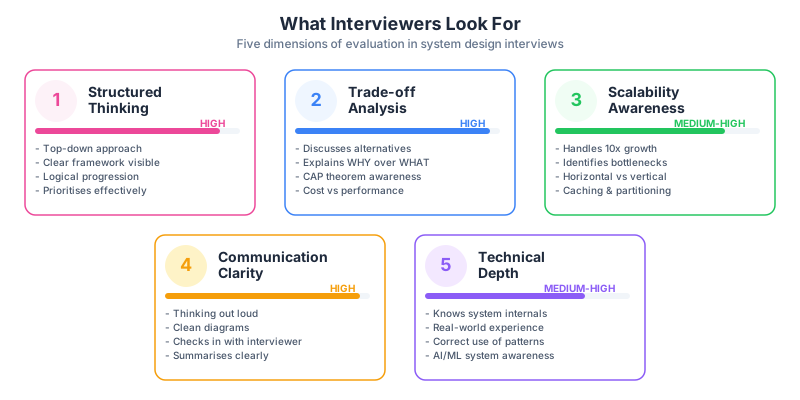
What Interviewers Actually Score
Whiteboard & Diagram Best Practices
| Do | Don't | |----|-------| | Use consistent shapes (boxes for services, cylinders for DBs) | Draw a wall of text | | Label every component and arrow | Assume the interviewer tracks unlabelled lines | | Use colour or grouping to show layers | Crowd everything into one corner | | Write capacity numbers on components | Leave scale ambiguous | | Erase and redraw when the design evolves | Scribble corrections on top of existing drawings |
How to Handle "Design X" Questions
A repeatable approach for common prompts:
"Design a URL shortener"
- Clarify: Write-heavy or read-heavy? Custom URLs? Analytics?
- Key decisions: Hashing vs counter, SQL vs NoSQL, caching layer
- Deep dive: Collision handling, redirect latency, analytics pipeline
"Design a chat application"
- Clarify: 1:1 or group? Message persistence? Read receipts?
- Key decisions: WebSocket vs polling, message storage, presence service
- Deep dive: Fan-out strategy, delivery guarantees, offline sync
"Design an ML recommendation system"
- Clarify: Recommendation type? Real-time or batch? Cold start handling?
- Key decisions: Collaborative vs content-based, feature store, serving infra
- Deep dive: Model training pipeline, A/B testing framework, feedback loops
🤯
Google's system design rubric weighs "Structured Approach" and "Communication" at 40% of the total score. You can have a technically imperfect design and still pass if your process is excellent.
Time Management Tips
- Set a mental timer for each phase — don't let Clarify eat into Deep Dive
- If stuck, say so — "I'm not sure about the best approach for X, but here's how I'd reason through it..."
- Check in every 10 minutes — "Does this direction make sense? Should I go deeper here?"
- Save 5 minutes for wrap-up — summarising well leaves a strong final impression
💡
Practice with a real timer. Record yourself answering "Design Twitter" in 45 minutes. Watch it back — you'll immediately spot where you lose structure or spend too long on setup.
Practice Checklist
- [ ] I can explain the 4-phase framework from memory
- [ ] I've practised at least 3 different "Design X" problems with a timer
- [ ] I naturally verbalise my thinking process while drawing
- [ ] I check in with my interviewer at transitions between phases
- [ ] I always discuss trade-offs, not just the "happy path"
- [ ] I can sketch clean, labelled diagrams quickly
Lesson 2 of 30 of 3 completed