AI EducademyAIEducademy
๐ŸŒณ

AI Foundations

๐ŸŒฑ
AI Seeds

Start from zero

๐ŸŒฟ
AI Sprouts

Build foundations

๐ŸŒณ
AI Branches

Apply in practice

๐Ÿ•๏ธ
AI Canopy

Go deep

๐ŸŒฒ
AI Forest

Master AI

๐Ÿ”จ

AI Mastery

โœ๏ธ
AI Sketch

Start from zero

๐Ÿชจ
AI Chisel

Build foundations

โš’๏ธ
AI Craft

Apply in practice

๐Ÿ’Ž
AI Polish

Go deep

๐Ÿ†
AI Masterpiece

Master AI

๐Ÿš€

Career Ready

๐Ÿš€
Interview Launchpad

Start your journey

๐ŸŒŸ
Behavioral Mastery

Master soft skills

๐Ÿ’ป
Technical Interviews

Ace the coding round

๐Ÿค–
AI & ML Interviews

ML interview mastery

๐Ÿ†
Offer & Beyond

Land the best offer

View All Programsโ†’

Lab

7 experiments loaded
๐Ÿง Neural Network Playground๐Ÿค–AI or Human?๐Ÿ’ฌPrompt Lab๐ŸŽจImage Generator๐Ÿ˜ŠSentiment Analyzer๐Ÿ’กChatbot Builderโš–๏ธEthics Simulator
๐ŸŽฏMock InterviewEnter the Labโ†’
JourneyBlog
๐ŸŽฏ
About

Making AI education accessible to everyone, everywhere

โ“
FAQ

Common questions answered

โœ‰๏ธ
Contact

Get in touch with us

โญ
Open Source

Built in public on GitHub

Get Started
AI EducademyAIEducademy

MIT Licence. Open Source

Learn

  • Academics
  • Lessons
  • Lab

Community

  • GitHub
  • Contribute
  • Code of Conduct
  • About
  • FAQ

Support

  • Buy Me a Coffee โ˜•
  • Terms of Service
  • Privacy Policy
  • Contact
AI & Engineering Academicsโ€บ๐ŸŒŸ Behavioral Masteryโ€บLessonsโ€บThe STAR Interview Framework
โญ
Behavioral Mastery โ€ข Intermediateโฑ๏ธ 15 min read

The STAR Interview Framework

The STAR Interview Framework - Structure Your Stories for Maximum Impact

You have brilliant experience. You have solved hard problems, led teams, and shipped products under pressure. But if you cannot tell that story clearly in 90 seconds, the interviewer will never know.

The STAR framework transforms rambling anecdotes into compelling, structured answers that prove your value with evidence.

Why Unstructured Answers Fail

Most candidates lose marks not because they lack experience, but because their answers meander. Interviewers are trained to listen for specific signals: ownership, impact, collaboration, and learning. Without structure, those signals get buried in noise.

๐Ÿ’ก

Hiring managers report that over 60% of candidates fail behavioural rounds not due to lack of experience, but because they cannot articulate it clearly. Structure is your competitive edge.

The Formula: S-T-A-R

Situation - Set the scene in two to three sentences. Where were you? What was the context?

Task - What was your specific responsibility? What needed to happen?

Action - What did you do? This is the heart of your answer. Use "I", not "we".

Result - What was the measurable outcome? Quantify it. What did you learn?
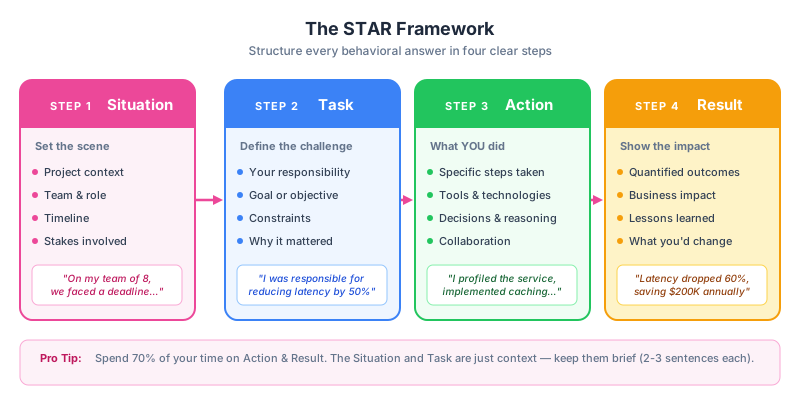
STAR framework diagram showing the four stages: Situation, Task, Action, Result flowing left to right
The STAR framework keeps your answer focused and impactful.

Example 1: Technical Challenge

Situation: Our payment service was experiencing 3-second latency spikes during peak hours, causing a 12% drop in checkout completions.

Task: As the tech lead, I needed to diagnose and fix the issue within our two-week sprint without disrupting the live system.

Action: I profiled the service and discovered N+1 database queries in the order validation path. I redesigned the data access layer to use batch queries, added Redis caching for frequently accessed product data, and implemented circuit breakers to prevent cascade failures.

Result: Latency dropped from 3 seconds to 180 milliseconds. Checkout completion rates recovered fully, adding an estimated ยฃ2.1 million in annual revenue. The pattern became our team's standard for all high-traffic services.

Example 2: Conflict Resolution

Lesson 1 of 80% complete
โ†Back to program

Discussion

Sign in to join the discussion

Suggest an edit to this lesson

Situation: Two senior engineers on my team disagreed strongly about whether to build a custom ML pipeline or adopt a managed service. The debate was blocking our quarterly roadmap.

Task: I needed to resolve the disagreement, keep both engineers engaged, and deliver a decision the team could rally behind.

Action: I facilitated a structured decision meeting using a weighted scoring matrix. Each engineer presented their case against criteria we agreed on: cost, time-to-market, maintainability, and team skill gaps. I then ran a two-day spike on the managed service to gather real data.

Result: The data showed the managed service saved eight weeks of development time. Both engineers accepted the outcome because the process was transparent. We shipped the feature a month ahead of schedule.

Example 3: Leadership

Situation: Our company acquired a startup, and I inherited a team of six engineers with a completely different tech stack and engineering culture.

Task: I needed to integrate the team, align on shared practices, and deliver a unified product within one quarter.

Action: I ran one-to-one meetings with every team member in the first week to understand their strengths and concerns. I created a shared engineering playbook collaboratively rather than imposing our existing standards. I paired engineers from both teams on integration tasks to build relationships through shared work.

Result: We delivered the unified product on time. Retention was 100% through the integration period. The collaborative playbook approach was adopted company-wide for future acquisitions.

๐Ÿค”
Think about it:

Pick one achievement from the last year. Can you tell the story in under 90 seconds using STAR? Time yourself. If you go over, your Situation section is probably too long.

Common Mistakes

Too much Situation, too little Action. Candidates spend 60% of their answer setting the scene. Aim for 10% Situation, 10% Task, 60% Action, 20% Result.

Using "we" instead of "I". Interviewers want to know what you did. Collaboration is good, but be specific about your individual contribution.

Vague results. "It went well" is not a result. Quantify: revenue gained, time saved, users impacted, incidents prevented, percentage improvements.

๐Ÿง Quick Check

In the STAR framework, which section should take up the most time in your answer?

Quantifying Impact: Numbers That Prove Your Value

Weak results sound like opinions. Strong results sound like facts.

| Weak | Strong | |------|--------| | "Improved performance" | "Reduced API latency by 74%, from 1.2s to 310ms" | | "Saved money" | "Cut infrastructure costs by ยฃ45,000 per year" | | "Helped the team" | "Mentored 3 junior engineers, 2 promoted within 12 months" | | "Fixed bugs faster" | "Reduced mean time to resolution from 4 hours to 35 minutes" |

๐Ÿคฏ

Research from Google's hiring team found that candidates who quantified their results in at least two STAR answers were twice as likely to receive a "strong hire" recommendation compared to those who gave qualitative answers only.

๐Ÿง Quick Check

Which of these is the best result statement for a STAR answer?

Your Practice Template

For each role you are preparing for, write out five STAR stories covering these themes:

  1. Technical challenge - a hard problem you solved
  2. Conflict or disagreement - how you navigated people dynamics
  3. Leadership or influence - a time you led without authority
  4. Failure and learning - what went wrong and what you took from it
  5. Impact at scale - something that affected the business meaningfully
๐Ÿค”
Think about it:

Write your "failure and learning" STAR story right now. This is the one most candidates skip preparing - and the one interviewers love to ask. The best answers show self-awareness and growth.

๐Ÿง Quick Check

What is the biggest mistake candidates make with the Situation section of a STAR answer?

Key Takeaways

  • Structure beats brilliance. A well-structured average story outperforms a brilliant but rambling one.
  • Action is the star of STAR. Spend most of your time here.
  • Numbers are non-negotiable. Every result should have at least one quantified metric.
  • Prepare five stories, cover any question. Most behavioural questions map to the five themes above.

Practice out loud. Record yourself. Time yourself. The difference between a good candidate and a great one is preparation.